


Ode to Divorce-War of Roses, Roses, Splitsville

War of Roses and Roses, examine what could be considered in their own time, as an ideal relationship. In War of Roses we have Danny Devito frame the story, which he is telling to a possible future client as a warning. He tells us that while we perceive this to be a fortuitous start, he views these small details as telling that the Rose’s relationship was always doomed. The Roses find each other over a shared interest, have two children, and support each other until they reach financial success through the husband's career. A normal successful family as portrayed in the late 80’s and 90’s.
How much of the relationship is validation through material possession or sincere emotion, and does the love story obscure which is which for the characters? Jonathan Rose continues a linear progression in the story from law student to successful lawyer, bringing his family along with the ideals he holds with support from his wife Barbara. Barbara Rose lacks direction initially, adapts to the role of supportive wife, passive aggressively at times, and then concentrates on renovating her dream home that she manages to finagle the purchase of. All of this rests until the tense moment of Jonathan’s health scare. In this challenge to their relationship Jonathan writes a dying note to his wife telling her how much he loves her, and Barbara learns that she no longer loves Jonathon, nor wishes to continue in their life together.
Jonathan goes through various stages of shock and loss, taking Barbara’s decision like a sucker punch. Things went how he wanted in life, and he suffered the minor inconveniences he didn’t enjoy to accomplish what he has now. His processing of his divorce is underscored by his conversations with other divorce attorneys explaining what is in his best interest for the future. In the film Jonathan’s motivation is torn between not losing the fruits of his labor and disbelief that Barbara would leave him. Barbara on the other hand wants to move on. She starts a catering business prior to the initial unraveling of the relationship that brings her hope of an independent future.
In the book, Jonathan’s motivation for wanting to keep the house is shown to be an emotional attachment to things in the household itself, in addition to the emotional processing of other losses. The couple initially come together over the collection of valuable figurines that Jonathan's mother had some of when he was young. In the final fight he starts hoarding those figurines in a closed off room. The book also has a dalliance with the house keeper that doesn’t amount to too much besides fleshing out the housekeeper character, and explaining some of the additional attachment she has to the Roses. The book and the movie both end with them stuck in this stage, emotions unprocessed, fighting to the death in the home they built together.
Roses is described as a reimagining of the War of Roses, and the characters and supporting characters share nothing in common. The inclusion of the house as a focal point for the couple appears to be a physical manifestation of the couple's emotions rather than an obsession with materialism. The house they fight over is Theo’s life long passion project and his second chance to revive his career after learning how to be a stay at home parent. Ivy, who never particularly cared for the home, wants Theo to suffer for failing to appreciate and love her despite her growing selfishness as she receives more attention.
Is it a loving relationship? There is no narrator to advise you that they are doomed from the start. What you have is the odd way that they relate to each other. Both have some unhealthy habits that they accept as part of their relationship. Including an ongoing bit where Ivy continuously eats raspberries that she is highly allergic to, with the expectation that Theo will always administer her epi-pen. Theo’s gifting of the restaurant to Ivy comes before the failure of his career. We see Theo work through the depression of losing his livelihood, to adjusting to being a stay at home dad in a manner he is comfortable with. Ivy grows slowly resentful of her children and Theo’s close relationship, while being happy with her own success. In this version, there is a clear trajectory of them growing apart and no longer relating to each other.
As much as they can’t feel positively about each other's company, they still have a connection that keeps them together. Their couples therapist tells them to separate, and their children celebrate the news. The couples in their life share their own perspective, like the pursuit of freebies, or imaging other people when they have sex to keep the spark alive. Relationships are hard, but they do still have a deep connection and love for each other. Roughly the point that Danny Devito concludes on in the War of Roses, when he highlights to his possible client that the emotions involved in divorce can lead to death. Can’t he just suck it up and keep his relationship alive?
Roses addresses this head on and makes the counter point. The emotional pettiness almost kills both parties, but this turns into reconciliation. The adrenaline finally results in Theo and Ivy expressing their emotions, but their toxic avoidance still leads to their death. I found that refreshing, since it gives a divorce a breather from being the central problem.
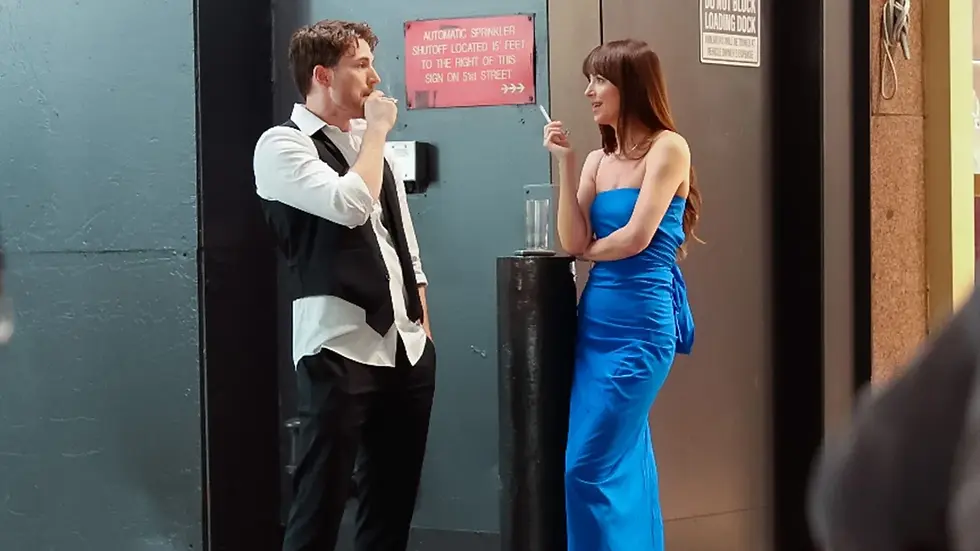
Splitsville has not one, but two divorces, one open marriage, and the happy new common occurrence of being broken up and living with one's ex. It does so much with so few principal characters exchanging partners. Splitsville doesn’t necessarily ask if marriage itself is a problem, but it offers different takes on approaches to deal with a marriage, as well as a relationship that has become unfulfilling. It also calls to mind the hiding of emotion in others and whether that is genuine or not, in a completely different manner than War of the Roses.
Is the open marriage to avoid boredom, or ease tensions that come with the fear of losing the one we love? While one set of married friends (Julie and Paul) have an open marriage, neither are utilizing the option, but neither are sure if the other is utilizing it. This means that they had a sit down open conversation where they discussed rules for each other, but could not have any further conversation about how that made them feel. When this open relationship is tested for the first time, large emotions ensue that don't actually lead them to discussing their insecurities. Only after Julie and Paul get a divorce due to Paul taking bad credit to float his company, do they start addressing that neither of them wanted an open marriage in the first place.
Cary and Ashley on the other hand, get a divorce because after watching someone die Ashley comes to terms with only having gotten married as a natural evaluation of their relationship. Cary freaking out is a constant pleasure in Splitsville, from the opening to the end, with his more awkward moments being his emotionally quiet ones. Cary refuses to move out post divorce, befriending all of Julie’s lovers and temporary boyfriends as she moves on. These newcomers give us new perspectives and a wider range of interactions, while haunting Julie through her newly single life. As Cary points out, the bright side of the arrangement is he finally starts making friends instead of being obsessed with his love interest.
Cary later confesses to having only stayed in their home and befriending Ashley’s exes as a way to get back together with her. But then, only after Ashley makes a play to get Cary back after he moved on and is living with newly divorced Julie. It is all as messy as the beginning of the film promises, but all the characters do experience emotional growth while living these bizarre moments. No one seems to know what they are doing, but they know they don’t know what they are doing, and try to learn and resolve their issues
Notes: I discovered that War of Roses has been used as a term for an exceptionally bad divorce in Germany.
Written by Natasha Melbrew
09/11/2025


Comments